

Twin Talks COP30:
Unlocking Capital and Technology for Southeast Asia’s Energy Transition

By Rory Linehan,
Director of Infrastructure Policy Advancement, Bentley Systems
If you weren’t able to join us in Belém, you can watch the full Twin Talks COP30 conversation and see photos from the session below:
At COP30 in Belém, one thing was abundantly clear: the global energy transition is no longer constrained by ambition or awareness; it is constrained by execution. According to McKinsey, the world requires an estimated USD 106 trillion in infrastructure investment by 2040. The good news is that the capital exists, with the UNDP estimating over USD 450 trillion in global wealth. The challenge is mobilizing it, at speed, at scale, and into the places where it is most urgently needed.

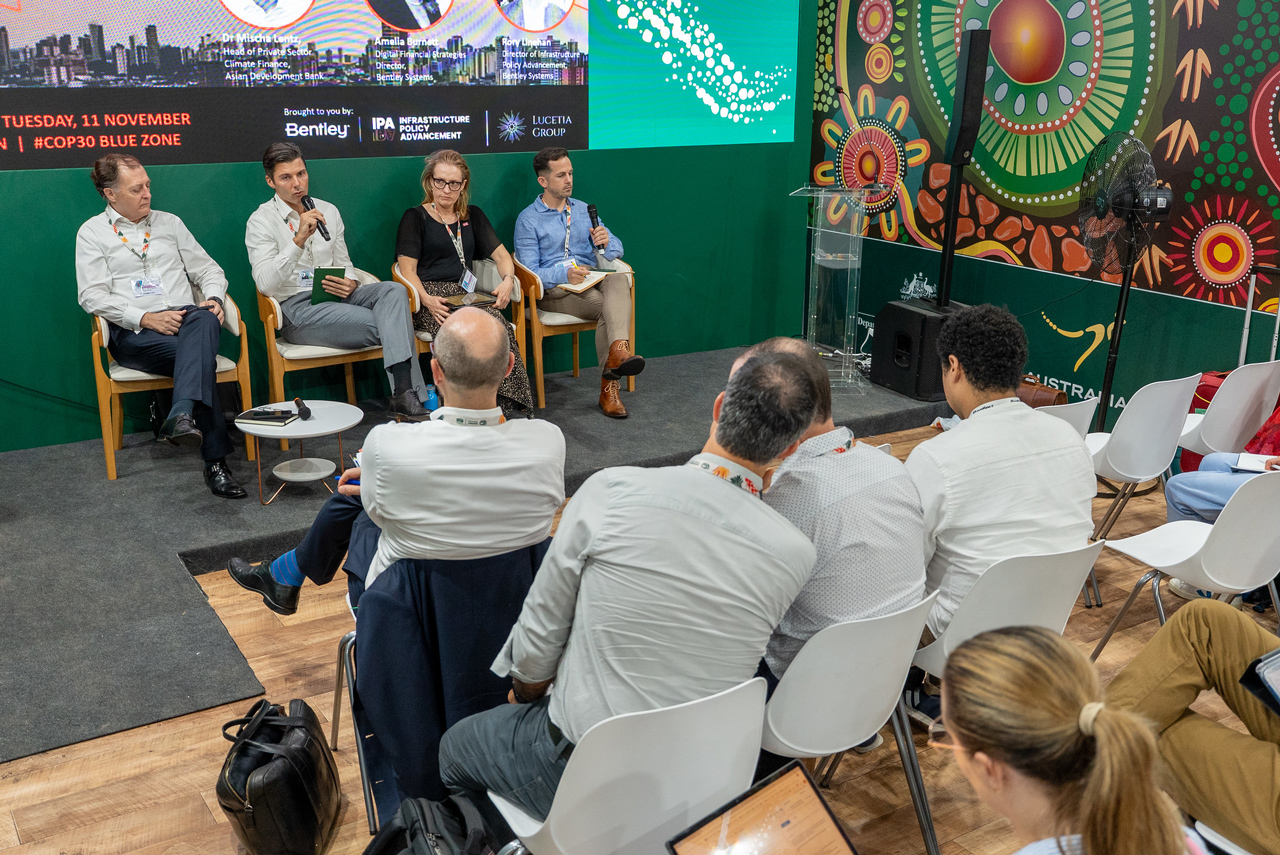
Twin Talks COP30 Panelists (l to r), Philippe Valahu, Dr. Mischa Lentz, Rebecca Mikula-Wright, and moderator Rory Linehan
A 2025 report from the World Meteorological Organization (WMO) shows the world is on track to breach the 1.5°C warming goal set out in the Paris Agreement, with infrastructure and energy systems responsible for the majority of global emissions. Capital must move faster, into more complex markets, and toward projects that are harder to structure than those in developed economies. That disconnect between abundant capital and under-investment in sustainable infrastructure is not theoretical, it is playing out in real time.
This tension is one I’ve encountered repeatedly throughout my career, including during my time at the Inter-American Development Bank and earlier at the G20 Global Infrastructure Hub, where private capital mobilization for infrastructure in emerging markets was a core focus of my work. As I noted during the Twin Talks discussion, “the capital exists; the question is how we can mobilize it.”
Too often, capital remains sidelined not because of a lack of appetite, but because projects are not investable in practice—not at the scale, risk profile, or maturity institutional investors require. Bridging that gap between capital availability and project bankability is where policy, finance, and technology must intersect far more deliberately.
FROM CAPITAL ABUNDANCE TO INFRASTRUCTURE ON THE GROUND

Bentley Systems’ Amelia Burnett provides framing remarks at Twin Talks COP30
Twin Talks COP30, hosted at the Australian Pavilion in the Blue Zone, was designed to confront that reality head-on. Opening the session, Bentley Systems’ digital financial strategies director, Amelia Burnett, grounded the discussion in the practical role technology must play in capital mobilization. Drawing on her experience at Bentley Systems and the G20 Global Infrastructure Hub, she highlighted a core barrier to scale, fragmentation, “an ecosystem where project developers, finance, insurers, policymakers, and technology providers are not always aware of each other’s challenges and opportunities.”
WHY AUSTRALIAN CAPITAL MATTERS FOR SOUTHEAST ASIAN INFRASTRUCTURE
Despite unprecedented levels of global wealth, only a tiny fraction is flowing into sustainable infrastructure in developing economies. Institutional investors hold around USD 100 trillion in global assets. As discussed on the panel, less than five percent of institutional investor assets are allocated to sustainable development in developing economies, with OECD analysis suggesting the figure may be closer to three to four percent.
The opportunity, however, is enormous. According to the Australian Government’s Invested: Australia’s Southeast Asia Economic Strategy to 2040, Southeast Asia faces an estimated USD 3 trillion infrastructure investment gap to 2040, with clean energy investment central to both development and decarbonization. Australia holds one of the world’s largest and fastest-growing pools of institutional capital, yet Australian investment in Southeast Asia remains underweight, representing just 3.4 percent of Australia’s total outbound investment stock.
THE BARRIERS TO DEPLOYING AUSTRALIAN INSTITUTIONAL INVESTMENT AT SCALE IN SOUTHEAST ASIA
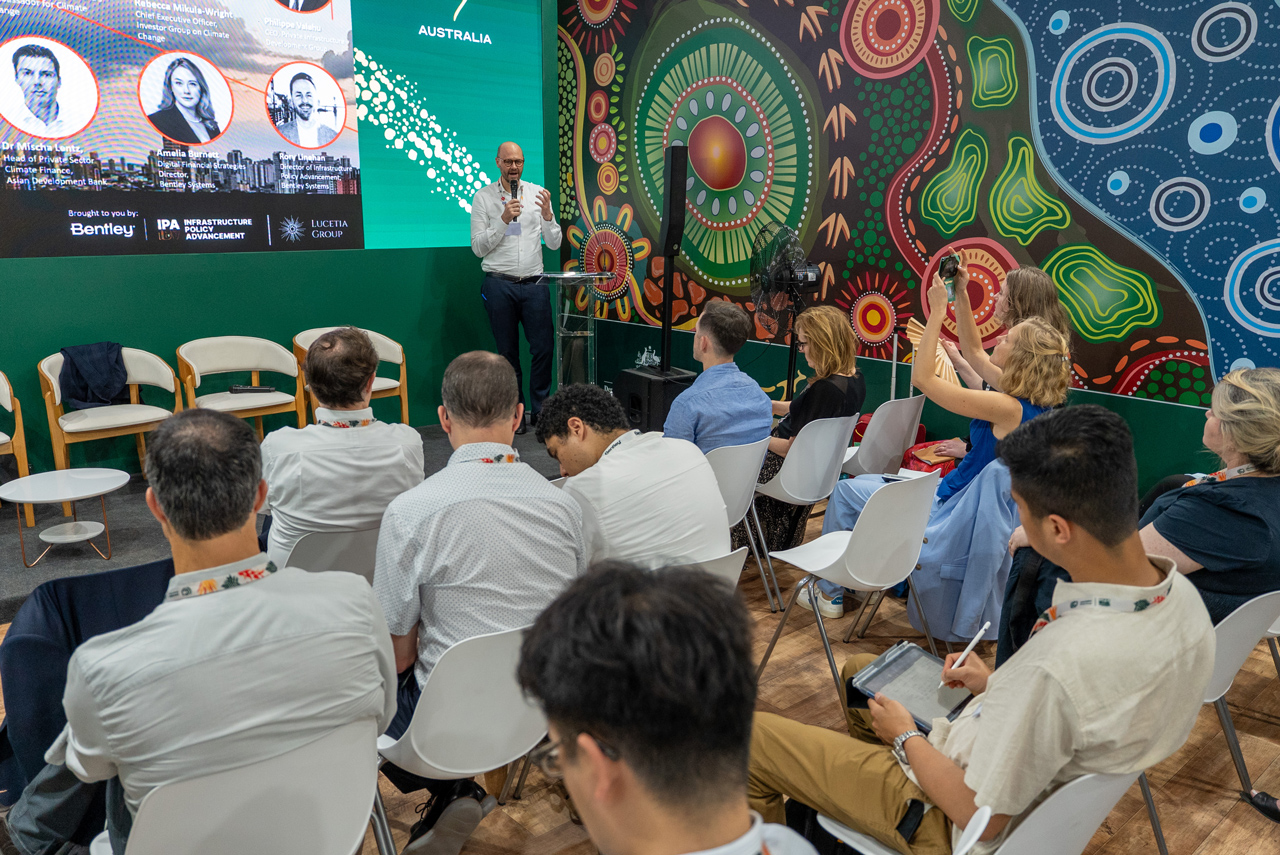
Will Nankervis, Australia’s Ambassador for Climate Change, shares an update on Australia’s Invested Strategy in his keynote address at Twin Talks COP30
In his keynote, Will Nankervis, Australia’s Ambassador for Climate Change, underscored the ambition of Invested and the Australian Government’s commitment to supporting the region’s energy transition. But as his remarks made clear, policy intent alone does not move capital. What moves capital is confidence, in projects, in data, and in long-term performance.
From the perspective of institutional investors, Rebecca Mikula-Wright, CEO of the Investor Group on Climate Change and the Asia Investor Group on Climate Change, was candid about the constraints institutional investors face. While asset owners are increasingly climate-aware and long-term in outlook, deploying capital at scale in southeast Asia remains difficult. As she noted, allocations to sustainable development remain “super low,” shaped by fragmented pipelines, regulatory uncertainty, currency risk, and insufficient project preparation.
That theme was reinforced by Philippe Valahu, CEO of the Private Infrastructure Development Group (PIDG), who drew from decades of experience financing infrastructure across emerging economies. His message was clear: high-quality infrastructure does not emerge by accident. It requires sustained preparation, clear risk allocation, and credible governance across the full asset life cycle.
TECHNOLOGY FOR DERISKING INVESTMENT
Where the discussion became most forward-looking was around the role of technology. Too often, technology is treated as a late-stage efficiency tool rather than core infrastructure for investment decision-making. Yet digital tools can fundamentally change how risk is understood, managed, and priced, particularly in emerging markets.
That point was brought to life by Dr. Mischa Lentz, head of the Private Sector Climate Finance Team at the Asian Development Bank, who shared examples from ADB’s work across Southeast Asia. He described how advanced data analytics and system-level modeling are being deployed early in project development to improve demand forecasting, optimize asset sizing, and stress-test performance under different climate scenarios, delivering not just better engineering but greater investor confidence.
Technology does not eliminate risk, but it makes risk visible, measurable, and manageable. For institutional investors, that distinction matters. As Rebecca observed, investors do not need perfection, they need clarity.
FROM CONVERSATION TO CAPITAL DEPLOYMENT
If we are serious about unlocking Australian capital for southeast Asia’s energy transition, technology must be embedded into infrastructure planning, project preparation, and asset management from inception through operation. This is not about innovation for its own sake, it is about building a credible pipeline of shovel-worthy infrastructure projects that meet fiduciary requirements while delivering long-term climate and development outcomes.
The next phase must be action-oriented. In 2026, Bentley’s Infrastructure Policy Advancement team, in partnership with Lucetia Group, will host a series of Twin Talks in Sydney and Singapore alongside a supporting report focused on how technology can help unblock Australian institutional investment into Southeast Asia’s green energy transition.
I’ve spent much of my career working at the intersection of capital, policy, and infrastructure delivery. The conclusion I keep returning to is simple, the wealth exists, the need is urgent, and the tools are already in our hands. The task now is to connect them, deliberately, collaboratively, and at pace and at scale.